Here's a couple of entries from my journal, to give you some idea of what my day to day life is like, and how much it varies:
Thursday, March 27, 2008
I really had to write today because today marks my being here 6 months in The Gambia. It's kind of hard to believe that 1/2 a year has passed already since I came here. For so long it seemed like time was moving by so slowly and it made 27 months seem really daunting. But all of a sudden, the last couple of months have gone by quickly and I'm almost 1/4 of the way done.
It's a good feeling to make it to 6 months. It's a pretty big milestone and according to the chart Peace Corps gives us, the hardest part is over now. And it feels that way even though I never felt that being here was that difficult. But now I have a home, a family, I can communicate in Wollof, I have work to do, friends (both Gambian and non-Gambian), a new puppy, and things to look forward to and plan.
The 6 month mark has also gotten me thinking about how far I've come since I got here, compared to when I first got off the plane and had no idea what to expect. The past two days I was in Leba, a small Fula village where my host family is originally from. My host family is actually Fula and speaks Pulaar even though I learned Wollof in training. Everyone but my mother speaks Wollof, but they speak Pulaar with each other so I'm trying to learn Pulaar now also. Anyway, my sister Tabara invited me to go along with her and my other sister Mare to visit their family in Leba. It was an offer I thought I shouldn't let go by, especially since Tabara will be getting married in a couple of weeks and moving to a neighboring village.
It was, I admit, an overwhelming experience, and in fact, reminded me a lot of my first day in training village: not understanding the language, not being able to communicate, being overwhelmed by all the people, the yelling, and babies with ringworm and snot-smeared faces crying. I felt a little like I was Tabara's pet the whole time, because I was always sitting waiting for her to tell me to follow her somewhere, or to tell me to come eat, or sleep, or bath or whatever, because I didn't know when or where to do any of those things and she was the only one besides Mare who spoke Wollof. She was great, though, and never showed that I was a burden on her in anyway. I'm sure it wasn't easy for her having me there, not only because she had to constantly be watching out for me, but because she probably got a lot of flack from other people in the village for bringing me in the first place.
The whole experience made me realize that even though we live here for two years, and supposedly are living as close as possible to the standard of living as the people here, our lives are very removed from what life is actually like here. For one thing, there is no such thing as personal space. The concept is completely foreign here, because from the time you are a baby you are always with other people. Even after just two nights I couldn't wait to get "home" to my personal space. Also, in the village I realized how spoiled I've become by town life. There was no fish or vegetables in their food bowls. Besides what they grew themselves (cere and milk), all they had was rice and a little bit of oil and onion. Everyday really is a struggle just to get food in the food bowl.
There were some big differences between going to Leba and my first day in training village though, that make me realize how far I've come in 6 months. For one thing, even though I can only speak a little Pulaar, I at least speak some Wollof so I could still communicate with some people. Second, not only did the food not bother me, I really, really loved it! I couldn't get enough of the fresh milk and cere (pounded millet). Third, I was there with a Gambian friend, who cared about me and was watching out for me. Fourth, my first thought in training village was "I have to do this for two years?", where as now, I thought "This is only for two days, and then I get to go home." Yes, my site feels like home now and I was really happy to be back today. I took a luxurious bucket bath, put some clean clothes on and went to the office and worked for a couple of hours then spent the rest of the afternoon reading Newsweeks in my house. It was great! Except for the fact that it was so hot that I was dripping sweat. Funnily enough, this will be the most permanent home I have had since graduating high school, and its beginning to feel that way.
Wednesday, April 2, 2008
I got sick on Monday and didn't start feeling better until this afternoon. I'm pretty sure I drank some bad water, because I remember drinking some unfiltered water at the office and thinking it tasted funny, almost carbonated. But I've had to drink the same water dozens of times when I ran out of my water and never had a problem, so I didn't think much of it.
A couple hours later it hit me all of a sudden. I was working on one of the office computers with Malick, one of the Agricultural Extensionists, typing a list of the 1st Quarter achievements for the Agriculture sector, and then within one minute I realized that, uh-oh, I need to go the bathroom now and then I need to go home and lay down and be near my latrine.
I had body aches, diarrhea and a low-grade fever that lasted until this morning. Tuesday during the afternoon was the worst because I had to deal with the unbelievable heat on top of being sick. But today I'm feeling better and went back to the office because I had a lot to get done.
I've been really busy at the office lately. Monday, we had a staff meeting, which was long but productive. After that I worked on consolidating the data we collected for a community group assessment that the staff conducted in the 27 communities we work in. I was put in charge of consolidating all the data from the reports in one document, which turned out to be a lot of work. I was supposed to have it done on Tuesday but since I was sick I had to work like mad today to get it done, and I still wasn't feeling that good. We also had our first meeting with the Agriculture staff, which went well once it was started an hour late. I called the meeting and set the agenda, and I'm trying to institutionalize it into a weekly meeting. It's definitely something that is needed and I hope it will help mobilize the Agriculture sector to start performing at a higher level.
I actually put in a full-days work today working from 9:00 to 5:15 with a 15 minute break for lunch, intermittent short breaks whenever the power shut down (at least 10 times a day) and my computer goes off (I've gotten used to saving documents every 10 seconds now) and another short break in the late afternoon when we found a snake in the storage room and everyone in the office was mobilized with sticks to kill it.
It might sound ridiculous that putting in a full days work is such a rare occurrence for me now, which I admit, it is. But you also have to consider the heat. It's getting above 120F in the afternoon now, according to my thermometer (which doesn't go above 120F, and yes I keep it in the shade) and the office has solar-power to run the computers, but there's not even enough extra power to run a fan, let alone AC. We don't even have lights installed since we only work in the day time anyway. The reason the power goes out so much already is because there's not enough juice being generated to power all the computers at once. Whoever is the last in the office in the morning has to warn everybody before they turn their computer on because it will invariably knock out all the other computers momentarily.
And so because it gets so hot, and there's no relief inside the office, everybody pretty much stops working after lunch. So you can appreciate the dedication and super-human strength it took for me to work through the afternoon, not feeling good, periodic power outages, watching a big, supposedly poisonous, snake getting killed, and sitting at the computer with sweat literally dripping off me and soaked through my clothes.
Tuesday, April 8, 2008


Tuesday, February 19, 2008
Life in the Slow Lane
.jpg)
I'm starting to feel more comfortable to life here. One of the biggest adjustments I’ve had to make to life here is to learn to take things slow. There are a lot of hours during the day where it gets just too hot to do anything but sit under the shade of a nearby tree. This is supposedly still the cool season, but my thermometer got up to 105F the other day, so I am afraid for the hot season which goes from March to June. And everything just takes longer here. Sweeping my house takes at least an hour, and I have to do it at least a couple times a week because everything just gets so dusty here. I also have to fetch my own water, which means walking to the water pump in the morning, filling up my 3 20L jerrycans (they're actually empty industrial size vegetable oil containers, and they're called badongs here).
It gets so hot during the day now that you really can't do anything between 12:00 - 4:00 every day. That makes it hard for a volunteer to get much done in terms of projects but that doesn’t mean that people aren’t doing anything during the day. They are constantly working just to put food on the table, especially the women. The women are usually up at dawn pounding rice or coos for the day’s meals (which from the few weak attempts I’ve made at pounding, I can testify is very hard work). They spend the day cooking meals outside or in a hot hut over a wood fire, and they fetch water which means going to the nearest water pump and filling up their badongs or wide-rimmed buckets which they then carry on their heads home. Many women also have gardens which they water both morning and evening and some also sell produce in the market. They usually do all this with a baby strapped to their backs. And this leaves them little time for anything else.
Because of all the work that has to be done throughout the day, kids start helping out at a very early age. It’s not uncommon to see a 6 year-old carrying around a 2 year-old. As soon as they are big enough, girls start fetching water, pounding, and cooking. They give the young girls small buckets to carry on their heads and mini pestles for pounding. You never see kids talking back to adults. As soon as they are told to do something by anyone older than them, regardless of who they are, they will do it without complaint. In the Peace Corps, they call this the “small boy system”. If you need some tea from the bitik, you just “small-boy” some kid standing around, give them some money and tell them to go to the bitik (the local shop) for you. The inverse of this system is that it is acceptable for children to ask adults for things, like money. And if a child is a part of your extended family, you are expected to help them with money for education, etc. in anyway that you can. This creates a mutually beneficial system and strong social fabric. Old people are cared for and respected. And even though children have to do a lot of work for their elders, every adult was a child at one point in their life and had to go through the exact same thing.
Life has a rhythm here, the rhythm of the land, which is something that I’ve never experienced before and is something that I think is missing from our fast-paced, frantic lives. The only rhythm I was really acquainted with before was the daily rush hour to and from work. Here, you can't help but feel the rhythm each and every day.
Because of all the work that has to be done throughout the day, kids start helping out at a very early age. It’s not uncommon to see a 6 year-old carrying around a 2 year-old. As soon as they are big enough, girls start fetching water, pounding, and cooking. They give the young girls small buckets to carry on their heads and mini pestles for pounding. You never see kids talking back to adults. As soon as they are told to do something by anyone older than them, regardless of who they are, they will do it without complaint. In the Peace Corps, they call this the “small boy system”. If you need some tea from the bitik, you just “small-boy” some kid standing around, give them some money and tell them to go to the bitik (the local shop) for you. The inverse of this system is that it is acceptable for children to ask adults for things, like money. And if a child is a part of your extended family, you are expected to help them with money for education, etc. in anyway that you can. This creates a mutually beneficial system and strong social fabric. Old people are cared for and respected. And even though children have to do a lot of work for their elders, every adult was a child at one point in their life and had to go through the exact same thing.
Life has a rhythm here, the rhythm of the land, which is something that I’ve never experienced before and is something that I think is missing from our fast-paced, frantic lives. The only rhythm I was really acquainted with before was the daily rush hour to and from work. Here, you can't help but feel the rhythm each and every day.
The most important season is the planting season, where the main crops are sorghum, millet, peanuts and corn and begins just before the rains arrive. Then the rainy season sets in around June or July until harvest time in September. This is also called the hungry season because the food stores from the previous year start to run out before the new harvest comes in. At least in The Gambia, there are not famines but most families reduce their meals from 3 a day to 2 a day, and options, like meat or vegetables, become limited or non-existent. After harvesting begins the cold season when women plant their dry season gardens and plant rice in their rice fields for harvesting in January. After the rice harvest begins the hot season where there is little farming to do but it is too hot and dry to do anything anyway. The hot season lasts until May or June when its time to plant before the rains come. This is mixed with the rhythm of Islam, where you have the holy fasting month of Rammadan, the end of Rammadan celebration called Korite, and the biggest celebration is Tabasci which usually falls around Christmas and is a celebration of the story of Abraham where every family is expected to sacrifice a ram if they can. On top of that is the more constant rhythm of the days. You have the four daily calls to prayer at 6:00AM, 2:00PM, 5:00PM and 7:00PM where everybody stops what they are doing and goes to pray. You have the weekly luumo, or market, on Thursdays where people come from all over the region and Senegal. And then you have the endless naming ceremonies, weddings and funerals where huge numbers of people from all over attend.
As for what I’m actually doing here, I’m still trying to figure that out. I don’t have any problem keeping myself entertained, that’s never been a problem for me, and I spend a lot of time just sitting and talking with people, or really just listening since I still don’t speak Wolof that well yet. The day to day things end up taking a lot of my time here. I get up in the morning and make tea and breakfast and spend a little bit of quiet time enjoying the cool morning in my house, then I go work in my garden which is just near my house in the same compound, go back to my house, straighten things up, and head to the office to see what’s happening there.
At the moment, there’s not much for me to do at the office because right when I first arrived here there was a bit of a management crisis so it remains to be seen what my role will be still. But I help out in whatever way I can. We had two groups of visitors from the UK who came from AVISU's parent organization and I helped show them around and see the projects that AVISU is currently working on. I've also helped out with a couple of agricultural trainings for local farmers and gardeners, an agro-enterprise survey, a beekeeping survey, and then just basic computer skills training.
Besides working at the office, I'm also interested in working with the local schools. I’ve met with the headmasters at the lower basic, upper basic and senior secondary schools and discussed various things I could work on with them. I’m planning on starting a current events club at the high school and possibly working with one of the schools on the Peace Corps School Tree Nursery Competition.
Tuesday, January 8, 2008
Settling In to My New Life
I've been at site for a month now, and it feels good to finally be settling in somewhere. I can finally unpack all my bags, put up pictures, paint and make my house feel like my home. Of course, even though I've unpacked my bags, I still don't have anywhere to put all my things because I haven't been able to buy any furniture except for a bed and 2 chairs so far. So all the things laying on my floor may look disorganized to the untrained eye, but are in fact organized in a very complex master plan of floor space use.
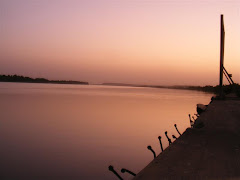
In some ways, the last 4 weeks have been very eventful and in other ways very little has happened. I think it mostly feels eventful because I have been learning and adjusting to so many new things, but in fact I have more free time than I've ever had in my life... and I like it. I stay busy; I've never been one to get bored. First, let me describe my site a little. I live in a town called Kaur that is about halfway up the country on the North Bank. When I say town, I really mean town. Kaur is probably about 4,000-5,000 people, but of course I'm completely guessing because nobody really knows. The town is situated near the Gambia river and used to be a bit of a port town with a peanut factory, cinema and night clubs. But over the past decade or two, the old businesses have shut down and died and many people have moved to the capital region on the coast, called Kombo. Now, Kaur is a big town, but a sleepy town, with wide sandy streets, a daily market and many well-meaning NGOs.
The primary reason that I was placed here is to work with an organization called AVISU, or Agency for Village Support. They are an all Gambian organization, that used to be an offshoot of the UK Village Aid organization, but they are now trying to make it on their own. The thing that I love about AVISU is that it is all Gambian run. Other than two VSO volunteers that are also working at the office (VSO is another volunteer organization like the PeaceCorps), everyone who works there is Gambian. I arrived at site right around the holiday season (Muslim's celebrate Tabasci just a few days before Christmas) so I'm still trying to feel out what my role will be at this point. But I really like the people that work at the office, and since my house is just across the street, I spend most of my free time sitting under the mango tree and drinking ataaya with Solo, the security guard and my guardian angel, and some of the other guys from the office. We listen to Senegalese mbaxal music most of the time, but since I donated some tapes I brought from Goodwill before leaving the States, The Bodyguard and TLC have been thrown into the mix fairly often.
For the most part, life is starting to feel pretty comfortable for me. The language is still a struggle, but I'm improving "ndanka, ndanka" as they say. One of my difficulties with the language is there are three different languages spoken in my village. The part of town I live in is mostly Wollof which is what I am learning now, but there are also some Fulas throughout town. In fact, my host family is a Fula family, and even though everyone but the mother speaks and understands Wollof, when they're speaking to each other, they speak in Pulaar (the Fula language) so I have no idea what they're talking about. The other, and larger, part of my town is Mandinka, and since I don't know more than a few simple greetings in Mandinka, I haven't ventured too much into that part of town. Many people do speak English in Kaur. At the office everyone speaks English, and children learn English in school. Sometimes I wish they didn't speak English, though, because everyday I have to listen to "Toubab, how are you? how are you?" screamed by little children, and sometimes adults, as I walk through town. It can really grate on your nerves, especially when your walking down a sandy road in the heat, your dirty and sweaty, and you're already stressed just trying to adjust to everything. Toubab is what all white people are called here, and it's really not meant as an insult, but shouted at you a 100 times a day, it has the effect of making you feel isolated and even more different than you already feel.
Another thing that has been difficult for me to get used to is constantly being asked for things. And it has taken me awhile to understand that there is no polite way of asking for things in this culture, it is simply, "Give me". So everyday walking through town I have people say "Toubab, give me your bicycle", "Give me money", "Give me your water bottle", "Give me your sunglasses", "Give me your shoes", "Take me to America". I have to admit, that was probably the thing that I had the hardest time with when I first got to site. From my perspective, I feel like I'm already here giving my time and energy to help these people, and when you hear things like that, you feel like nothing you do will ever be enough to satisfy them. But now, I can see things from their perspective a little more clearly. First of all, asking for things is just part of the culture here, and once I realized that people do this to each other and not just me, it stopped bothering me nearly as much. Second of all, people here have a very rough sense of humor, and they tease each other mercilessly. So when they say "Give me", they don't really expect you to give them anything. They're just poking you to see how you'll react, and if you make a joke out of the whole thing, you gain they're instant respect and friendship. So now when a kid says "Give me money, I say "Aca!" which is what you say to shoo goats and they think this is hilarious. Or I start chasing them, which really catches them off guard, because a lot of kids are actually very afraid of toubabs (apparently our eyes glow red at night). Third of all, and this is on a more somber note, there really are a lot of toubabs and NGOs that come here and hand out money and free things, which is definitely well-intentioned and may help many people. Unfortunately, the downside of this is that many people here think that all white people are just filthy, stinking rich and here to give handouts. It does not encourage a "can do" attitude to say the least.
So, in a nutshell, I'm figuring out how to make things work for myself in my new life. And, mostly, I'm having a really good time. I'm also feeling out what work I want to do for the next 2 years that I'm here. I definitely have plenty of options between working with AVISU, schools, community gardens and individuals. And I'm staying busy. I'm starting a garden at my house, which I've never tried before, but I figure if I'm an Agriculture volunteer, I better start learning something about agriculture. I've been working with the Lower Basic school garden a little making organic pesticides from local materials. I've done a few things with AVISU so far, and I've been spending as much time as I can walking around town getting to know people.
I will be off the grid again for another month until I make it back to Kombo to do banking in February. But please email me or write me if and when you can. It really means so much to me to hear from back home. I hope everyone is well, and know you are in my thoughts!
In some ways, the last 4 weeks have been very eventful and in other ways very little has happened. I think it mostly feels eventful because I have been learning and adjusting to so many new things, but in fact I have more free time than I've ever had in my life... and I like it. I stay busy; I've never been one to get bored. First, let me describe my site a little. I live in a town called Kaur that is about halfway up the country on the North Bank. When I say town, I really mean town. Kaur is probably about 4,000-5,000 people, but of course I'm completely guessing because nobody really knows. The town is situated near the Gambia river and used to be a bit of a port town with a peanut factory, cinema and night clubs. But over the past decade or two, the old businesses have shut down and died and many people have moved to the capital region on the coast, called Kombo. Now, Kaur is a big town, but a sleepy town, with wide sandy streets, a daily market and many well-meaning NGOs.
The primary reason that I was placed here is to work with an organization called AVISU, or Agency for Village Support. They are an all Gambian organization, that used to be an offshoot of the UK Village Aid organization, but they are now trying to make it on their own. The thing that I love about AVISU is that it is all Gambian run. Other than two VSO volunteers that are also working at the office (VSO is another volunteer organization like the PeaceCorps), everyone who works there is Gambian. I arrived at site right around the holiday season (Muslim's celebrate Tabasci just a few days before Christmas) so I'm still trying to feel out what my role will be at this point. But I really like the people that work at the office, and since my house is just across the street, I spend most of my free time sitting under the mango tree and drinking ataaya with Solo, the security guard and my guardian angel, and some of the other guys from the office. We listen to Senegalese mbaxal music most of the time, but since I donated some tapes I brought from Goodwill before leaving the States, The Bodyguard and TLC have been thrown into the mix fairly often.
For the most part, life is starting to feel pretty comfortable for me. The language is still a struggle, but I'm improving "ndanka, ndanka" as they say. One of my difficulties with the language is there are three different languages spoken in my village. The part of town I live in is mostly Wollof which is what I am learning now, but there are also some Fulas throughout town. In fact, my host family is a Fula family, and even though everyone but the mother speaks and understands Wollof, when they're speaking to each other, they speak in Pulaar (the Fula language) so I have no idea what they're talking about. The other, and larger, part of my town is Mandinka, and since I don't know more than a few simple greetings in Mandinka, I haven't ventured too much into that part of town. Many people do speak English in Kaur. At the office everyone speaks English, and children learn English in school. Sometimes I wish they didn't speak English, though, because everyday I have to listen to "Toubab, how are you? how are you?" screamed by little children, and sometimes adults, as I walk through town. It can really grate on your nerves, especially when your walking down a sandy road in the heat, your dirty and sweaty, and you're already stressed just trying to adjust to everything. Toubab is what all white people are called here, and it's really not meant as an insult, but shouted at you a 100 times a day, it has the effect of making you feel isolated and even more different than you already feel.
Another thing that has been difficult for me to get used to is constantly being asked for things. And it has taken me awhile to understand that there is no polite way of asking for things in this culture, it is simply, "Give me". So everyday walking through town I have people say "Toubab, give me your bicycle", "Give me money", "Give me your water bottle", "Give me your sunglasses", "Give me your shoes", "Take me to America". I have to admit, that was probably the thing that I had the hardest time with when I first got to site. From my perspective, I feel like I'm already here giving my time and energy to help these people, and when you hear things like that, you feel like nothing you do will ever be enough to satisfy them. But now, I can see things from their perspective a little more clearly. First of all, asking for things is just part of the culture here, and once I realized that people do this to each other and not just me, it stopped bothering me nearly as much. Second of all, people here have a very rough sense of humor, and they tease each other mercilessly. So when they say "Give me", they don't really expect you to give them anything. They're just poking you to see how you'll react, and if you make a joke out of the whole thing, you gain they're instant respect and friendship. So now when a kid says "Give me money, I say "Aca!" which is what you say to shoo goats and they think this is hilarious. Or I start chasing them, which really catches them off guard, because a lot of kids are actually very afraid of toubabs (apparently our eyes glow red at night). Third of all, and this is on a more somber note, there really are a lot of toubabs and NGOs that come here and hand out money and free things, which is definitely well-intentioned and may help many people. Unfortunately, the downside of this is that many people here think that all white people are just filthy, stinking rich and here to give handouts. It does not encourage a "can do" attitude to say the least.
So, in a nutshell, I'm figuring out how to make things work for myself in my new life. And, mostly, I'm having a really good time. I'm also feeling out what work I want to do for the next 2 years that I'm here. I definitely have plenty of options between working with AVISU, schools, community gardens and individuals. And I'm staying busy. I'm starting a garden at my house, which I've never tried before, but I figure if I'm an Agriculture volunteer, I better start learning something about agriculture. I've been working with the Lower Basic school garden a little making organic pesticides from local materials. I've done a few things with AVISU so far, and I've been spending as much time as I can walking around town getting to know people.
I will be off the grid again for another month until I make it back to Kombo to do banking in February. But please email me or write me if and when you can. It really means so much to me to hear from back home. I hope everyone is well, and know you are in my thoughts!
Subscribe to:
Posts (Atom)
.jpg)
.jpg)
.jpg)
.jpg)
.jpg)